
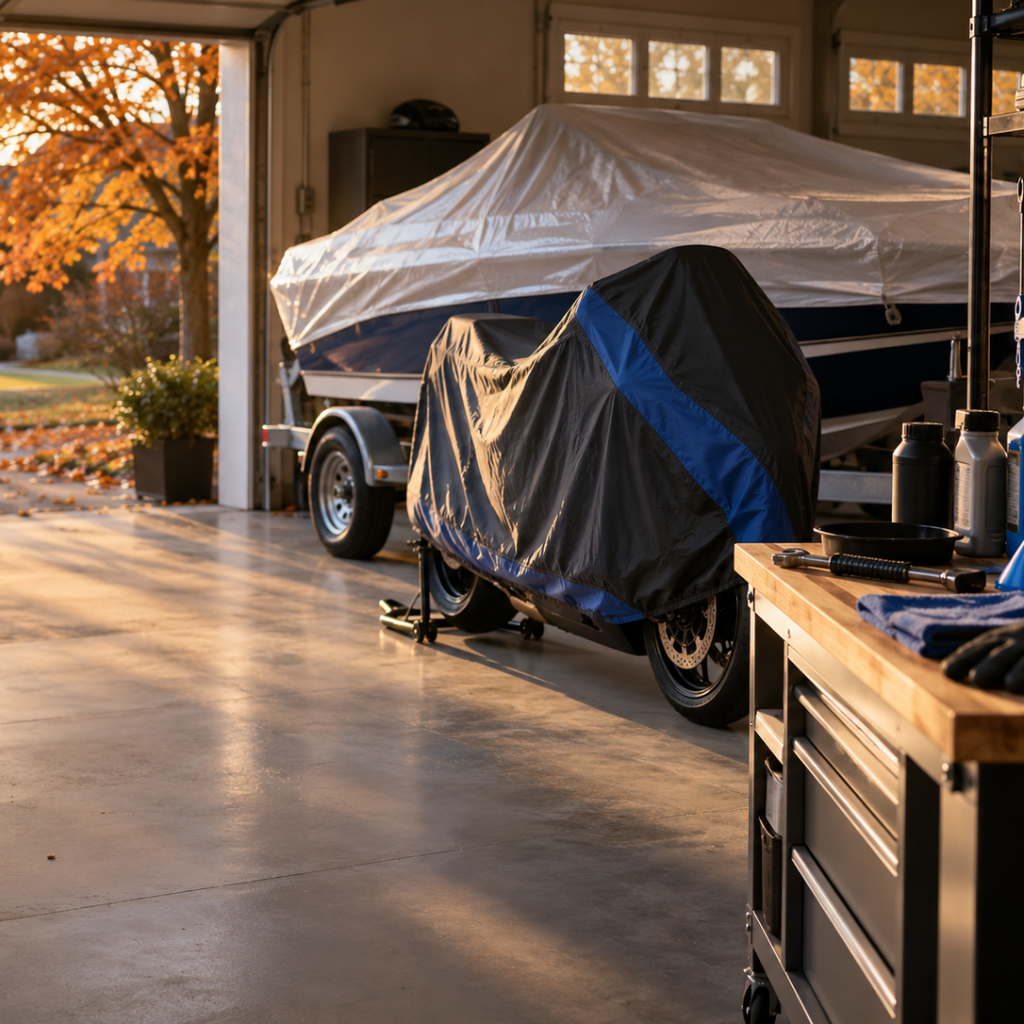

Key takeaways
- Theft does not take the winter off. Progressive's analysis of motorcycle theft found more than 2,800 bikes stolen in each individual winter month — during the season when owners are most likely to have dropped coverage.
- A gap in coverage follows you. Continuous coverage is a factor insurers commonly look at, and the premium you are quoted next spring after a five-month lapse may not be the premium you were paying last summer.
- In Indiana, a lapse on a road-registered vehicle is a state problem, not just a rate problem. Indiana's minimum liability requirement is 25/50/25, and reinstatement fees after an insurance-related suspension run $250 for a first offense, $500 for a second, and $1,000 for a third.
- There is almost always a middle option between "keep paying full price" and "cancel entirely" — reduced or comprehensive-focused coverage during the months a vehicle sits. Ask about it before you cancel, not after.
What's in this guide
- The question every Indiana owner asks in October
- What actually happens to a stored vehicle
- The four costs of cancelling
- The middle option: reducing coverage instead of dropping it
- Motorcycles: the Indiana road-registration wrinkle
- RVs and travel trailers
- Boats: layup season and the freeze question
- ATVs and UTVs
- A storage checklist worth doing anyway
- Frequently asked questions
The question every Indiana owner asks in October
Around the middle of October, when the evening rides get cold and the lake gets choppy, a version of this question lands on my desk every week: the bike is going in the garage until April — why am I paying to insure something I'm not using?
It is a reasonable question. Five months of premium on a machine sitting under a cover in a locked garage feels like money set on fire, and plenty of owners answer it by calling their carrier and cancelling.
The honest answer is that the instinct is right and the conclusion is usually wrong — because the premium you pay in the summer is not mostly for the risk of the bike sitting still. It is for the risk of the bike moving at 60 miles an hour on State Road 37. When the bike stops moving, that risk goes away, and so should most of that premium. But the risks that remain when it is parked — theft, fire, a tree through the garage roof, the storage unit that floods — do not go away at all. They just stop being visible.
So the useful framing is not cancel or keep paying. It is: which risks stop in October, and which ones don't?
What actually happens to a stored vehicle
Here is what makes storage risk hard to reason about: nothing happens to almost every stored vehicle, almost every winter. That is exactly why the intuition fails. Five uneventful winters teach you that storage is safe, and the sixth teaches you something else.
Progressive's look at motorcycle theft found that more than 2,800 motorcycles were stolen in each month of winter — not across the winter, in each individual month. Winter is when bikes are stolen, because winter is when they sit unattended in predictable places, and, uncomfortably, when a meaningful share are uninsured because their owners did the sensible-seeming thing.
The other storage-season losses are less dramatic and more common than people expect:
- Fire. Storage facilities burn. So do detached garages, and so do attached ones — often from something unrelated to the vehicle, like a furnace, a space heater, or a lithium-ion battery on a charger. That last one is why the NFPA has built Fire Prevention Week around safe charging two years running.
- Weather and structure failure. A heavy wet snow load or an ice storm brings down a limb, a carport, or a section of roof. The vehicle underneath is collateral damage.
- Water. Basement and low-bay storage floods during a February thaw, and melting snow finds the low point of a poorly graded lot.
- Vandalism. Less common, but it happens in commercial storage lots more than owners expect.
- The unseasonably warm Saturday. A 62°F day in late February is the day somebody rolls the bike out for an hour — and the day a lapse in coverage becomes a very expensive decision.
None of those risks care whether the engine has been started since October.
The four costs of cancelling
When owners run the numbers, they typically compare five months of premium against zero. That comparison leaves out four things.
1. The loss you can't recover. The obvious one and the largest. If the bike, the boat, or the camper is stolen or destroyed while uninsured, the entire value of it is gone. For a late-model touring bike or a travel trailer, that is a five-figure number against a saving usually in the low hundreds. You are effectively betting the full value of the asset to save a few months of premium.
2. The lapse itself. Insurers commonly consider whether a customer has maintained continuous coverage. Progressive states it directly: after cancelling, "you may end up paying more when you purchase a new policy because your motorcycle wasn't continuously insured." That is not a penalty in the punitive sense — it reflects how insurers assess risk — but the effect is the same. Some or all of what you saved in the winter comes back as a higher premium in the spring, and unlike the saving, it may persist for more than one season.
3. The lienholder problem. If the vehicle is financed or leased, your lender almost certainly requires you to keep it insured — usually including comprehensive and collision — for the full term, whether or not you are using it. Cancelling can put you in breach of your loan agreement, and lenders have a remedy: force-placed insurance, which is typically expensive and protects the lender's interest rather than yours.
4. The registration question. For anything registered for road use in Indiana, a lapse becomes a licensing and registration issue, not just an insurance one. More below.
The middle option: reducing coverage instead of dropping it
This is the part of the conversation most owners have never had, and it is the reason the phone call is worth making before the cancellation is.
The coverages on a recreational-vehicle policy do different jobs, and they map onto different risks:
Coverage type | What it responds to | Does the risk continue in storage?
Liability | Injury or damage you cause to others while operating | Largely no — a parked vehicle isn't being operated
Collision | Damage from a crash or impact while riding or driving | Largely no
Comprehensive | Theft, fire, vandalism, falling objects, weather | Yes — this is the storage risk
Uninsured/underinsured motorist | Being hit by someone with too little coverage | Largely no
Roadside/towing, accessory or gear coverage | Varies by policy | Varies
Look at that table and the logic of a storage-season adjustment writes itself. The coverages tied to operating the vehicle are the ones whose risk truly pauses. The coverage tied to owning it is the one that does not.
Different carriers handle this differently, and the options have different names — "laid-up," "winter layup," "storage coverage," or simply a mid-term coverage change. Progressive, for example, describes allowing riders to remove coverages while a bike is in storage or lower liability limits. On the marine side, winter layup arrangements are a long-standing convention: SkiSafe describes layup coverage as maintaining protection "against theft and other covered losses even when your boat is not in use," with freeze damage sometimes available as an add-on.
Two cautions worth stating plainly, because this is where people get hurt:
- Reducing coverage is a change to your contract, and the details are specific to your policy and carrier. What one company allows, another may not. Some do not offer a layup option at all.
- If you reduce liability and then ride on a warm February afternoon, you are riding on the reduced terms. Whatever adjustment you make, calendar the date you intend to put the vehicle back in service — and call before you ride, not after.
Coverage and any available options are determined solely by the terms of your own policy, your carrier's underwriting rules, and applicable Indiana law. Nothing here describes what any particular policy will do.
Motorcycles: the Indiana road-registration wrinkle
Motorcycles are the vehicle where cancelling has the most consequences, because a street-registered motorcycle is a motor vehicle under Indiana law and carries the same financial-responsibility obligations as a car.
Indiana's minimum liability requirement is 25/50/25 — $25,000 for bodily injury to or death of one person, $50,000 for two or more people in one accident, and $25,000 for property damage. The Indiana BMV states that all motorists operating a motor vehicle on Indiana roadways must maintain that minimum for the vehicle they operate.
The enforcement mechanism is what surprises people. The BMV can request proof of insurance — after an accident, after multiple violations in a year, after a serious violation, or for a previously suspended driver — and your insurer has to electronically file a Certificate of Compliance within 90 days. If that proof does not arrive, the result is a suspension. Insurers also file cancellation notices (SR26 forms) with the BMV, so a lapse is not invisible.
And the reinstatement fees escalate. For violations occurring after January 1, 2015, the Indiana driver's manual lists $250 for a first offense, $500 for a second, and $1,000 for a third or subsequent. There is a route to avoiding the fee by maintaining an SR22 filing continuously for 180 days while meeting other requirements — but at that point you are managing a state filing to recover from a decision made to save a few months of premium.
If you will not ride between November and March and you want to reduce cost, the productive question is not "can I cancel" but "what does an off-season adjustment look like on my policy, and what does it leave in place?" Our spring riding season guide covers Indiana motorcycle coverage in the riding months, and the motorcycle insurance page explains what a review with our team covers.
RVs and travel trailers
This is the distinction that causes the most confusion in the RV world, and it matters a great deal in October.
A motorhome — Class A, B, or C — is a motor vehicle. It drives itself, it is registered, and the same road-use logic applies to it as to a car or a motorcycle. Cancelling coverage on a registered motorhome raises the same Indiana financial-responsibility questions above.
A travel trailer or fifth wheel is not. It is towed. The tow vehicle's policy is generally the one doing the liability work while it is moving, and the trailer's own coverage is largely about the trailer itself and its contents.
That difference changes what "storage coverage" even means for each. For a motorhome, you are weighing liability and road risk against the physical-damage risk of the stored unit. For a trailer, you are almost entirely thinking about physical damage — theft, weather, fire, the tree that comes down in an ice storm.
Two things RV owners in Indiana consistently underestimate:
- Contents. Most people do not store an RV empty. The generator, the awning, the TV, the outdoor furniture, the bedding, the tools, the kitchen kit — an RV in storage is a small, well-equipped, unattended second home. How contents are treated varies by policy, and it is worth asking rather than assuming.
- Freeze damage. RV plumbing is small-diameter, exposed, and located in unheated bays. A unit that was not properly winterized can suffer significant plumbing damage over one Indiana cold snap. Whether and how a policy responds varies, and some contracts distinguish between sudden accidental damage and damage following a failure to maintain or winterize. That is a read-your-policy question, and a strong argument for winterizing properly regardless.
Our complete guide to RV insurance in Indiana walks through the coverage structure, and the RV insurance page covers what our team looks at in a review.
Boats: layup season and the freeze question
Boat owners have the longest tradition of formal off-season arrangements, which is why "layup" is a term of art in marine insurance rather than something an agent invented.
The basic idea is that a boat laid up for a defined stretch of consecutive months — hauled, shrink-wrapped, on a trailer or in a rack — presents a different risk profile than a boat in the water in July, and marine coverage has historically reflected that. SkiSafe summarizes the goal as maintaining coverage "both on and off the water, protecting against theft and other covered losses even when your boat is not in use," rather than dropping protection entirely.
The specifics that matter for an Indiana boat owner:
- The layup period is usually defined and binding. If the arrangement covers November through March, taking the boat out in the last week of March may fall outside it. Know your dates.
- Freeze damage is often treated separately. Marine engines and plumbing are extremely vulnerable to freezing, and a block cracked by trapped water is a serious loss. Whether freeze damage is included, excluded, or available as an add-on varies by policy — and some contracts condition it on documented winterization.
- Winterization is the actual protection. Engine flushed and stabilized, water systems drained, block and manifolds protected, batteries pulled and maintained, cover or shrink wrap that sheds water rather than pooling it. Nothing on a policy substitutes for this.
- Where it's stored changes the risk. A boat in a locked indoor facility, one under a carport, and one on a trailer in the side yard are three different exposures.
Our complete guide to boat insurance in Indiana covers the on-the-water side, and the boat insurance page covers what a review with our team includes.
ATVs and UTVs
Off-road vehicles are the category where the storage question is often the second problem, because the first is that a lot of owners are not sure what covers the machine in the first place.
The common assumption is that an ATV or side-by-side sitting in the garage is simply part of the household's property and therefore handled somewhere between the home and auto policies. Sometimes there is limited protection for an off-road vehicle at the residence; often the treatment is narrow and full of conditions — and it typically does not follow the machine to a trail, a friend's farm, or a riding area. That is why dedicated off-road coverage exists.
For the off-season, three things are worth knowing. Theft risk is real and concentrated — UTVs in particular are valuable, in demand, and frequently stored in outbuildings and pole barns rather than attached garages. Where it sits matters more than for other vehicles, since a machine in a barn on rural property is a meaningfully different exposure than one in an attached suburban garage. And accessories add up quietly: winches, plows, racks, audio, and cab enclosures can represent a substantial share of what an owner would need to replace, so how they are treated is worth asking about specifically.
If you use a UTV with a plow through the Indiana winter — plenty of people do — then it is not in storage at all, and the whole question changes. Our ATV and UTV guide covers the riding-season picture, and the ATV and off-road insurance page explains what our team reviews.
A storage checklist worth doing anyway
Regardless of what you decide about coverage, these reduce the odds of a claim in the first place — which is the outcome everybody wants.
- Store it somewhere locked and, if possible, indoors. The single biggest variable in theft and weather risk.
- Use a physical deterrent. A disc lock, a chain to a ground anchor, a cover for a bike; a coupler lock and wheel lock for a trailer. Opportunistic theft is discouraged by friction.
- Fuel stabilizer and a full or near-full tank for anything with a carbureted or older fuel system, to limit condensation and varnish.
- Battery on a tender, or removed and stored somewhere temperate. Charge lithium-ion batteries in an open area away from anything flammable, on the manufacturer's charger — the whole message of Fire Prevention Week 2026.
- Winterize the water systems on any RV or boat: lines drained or filled with the appropriate antifreeze, water heater drained, low points opened.
- Tires off the cold concrete where practical, and inflated to spec.
- A breathable cover, not a plastic tarp. Trapped moisture causes more corrosion than exposure does.
- Photograph everything before you cover it, including the odometer or hour meter and the accessories.
- Write down where the keys and title are. Every spring, somebody cannot find one.
- Put the spring date in your calendar — with a note to call your agent before the first ride, if you adjusted anything.
The bottom line
The instinct behind cancelling is sound — you should not pay for road risk on a vehicle that is not on the road. But the coverage that matters in storage is not the road coverage. It is the coverage that responds to theft, fire, weather, and the tree that comes down over the pole barn in February, and none of those risks go into storage with your bike.
Before you cancel anything this October, make one phone call and ask what an off-season adjustment looks like on your specific policy. The answer takes ten minutes and it is frequently better than either option most owners think they are choosing between.
If you want someone to look at how your motorcycle, RV, boat, or off-road coverage is set up before it goes under a cover, reach out to the AOG Group team for a personalized policy review, or call us at 317-981-2046.
About the author
Lee Boyer is a licensed Property & Casualty and Life & Health insurance agent with more than seven years at Allstate, all of them inside the AOG Group agency in Indiana. He writes about coverage the way he explains it at his desk — in plain English, without the sales pitch.
Sources
- Indiana BMV — Proof of Financial Responsibility (25/50/25 minimum liability requirement) · https://www.in.gov/bmv/licenses-permits-ids/suspension-and-reinstatement/proof-of-financial-responsibility/
- Indiana BMV — Indiana Driver's Manual, Chapter 5: Points, Suspension, and Insurance Requirements (Certificate of Compliance, SR22/SR26, reinstatement fee schedule) · https://www.in.gov/bmv/licenses-permits-ids/files/Drivers_Manual_Chapter_5.pdf
- SkiSafe — Winter Layup Boat Insurance Discounts (description of layup coverage and freeze-damage add-on) · https://www.skisafe.com/blog/Entry/8/winter-layup-boat-insurance-discounts
- NFPA — Fire Prevention Week 2026: "Charge into Fire Safety: Safe Charging Is a Superpower," October 4–10, 2026 · https://www.nfpa.org/about-nfpa/press-room/news-releases/2026/2026-fire-prevention-week-theme-announced
Frequently Asked Questions
Can I just cancel my motorcycle insurance for the winter in Indiana?
You can cancel a policy, but for a street-registered motorcycle it is worth understanding what you are taking on. Indiana requires liability coverage of at least 25/50/25 for motor vehicles operated on its roadways, insurers file cancellation notices with the BMV, and reinstatement fees after an insurance-related suspension run $250, $500, and $1,000 for first, second, and third offenses. On top of that, cancelling removes protection against theft and fire — the risks that continue in storage — and a lapse in continuous coverage may affect what you are quoted in the spring. Ask your agent about an off-season coverage adjustment before you cancel; on many policies there is a middle option.
What is comprehensive-only or laid-up coverage?
It is the general idea of keeping the coverage that responds to storage risks — theft, fire, vandalism, weather, falling objects — while reducing or removing coverages that respond to operating risks, like collision and, on some policies, liability. Carriers implement this differently and call it different things: "laid-up," "winter layup," "storage coverage," or just a mid-term change. Some do not offer it at all. Whether it is available to you, and exactly what it leaves in place, depends on your carrier and your specific policy.
Does my homeowners policy cover my motorcycle or ATV while it's in the garage?
Do not assume so. Home policies are written around the dwelling and personal property, and motorized vehicles are commonly treated as a distinct category with narrow and conditional treatment — which is precisely why separate motorcycle, RV, boat, and off-road policies exist. Some limited protection may exist for certain off-road vehicles at the residence under some contracts, but it varies enormously and rarely follows the machine anywhere else. The only way to know what your policy does is to check your policy.
Will my RV's frozen and burst water lines be covered?
That depends entirely on your policy, and it is one of the most contract-specific questions in this article. Many policies distinguish between sudden accidental damage and damage resulting from failure to maintain or winterize a unit, and some marine and RV policies treat freeze damage as a separate item or an optional add-on. The practical answer is the same either way: winterize properly, keep documentation that you did, and ask your agent to walk through the freeze-related language in your specific contract before the first hard freeze.
How much does keeping coverage through the off-season cost?
That varies by vehicle, value, storage situation, coverage selections, and carrier, so any specific figure would be misleading. The more useful frame is a comparison: the off-season cost of keeping the storage-relevant coverage in place, versus the full replacement value of the vehicle if it is stolen or destroyed, plus whatever a lapse does to your spring premium and any reinstatement cost. When owners see those two columns side by side, most decide differently than they expected to.